How Blending and Segmenting Sounds Makes Strong Readers
Jul 23, 2026
In our last post about phonemic awareness, we looked at 6 different levels of phonemic awareness. These 6 levels range from the simplest to the most difficult, and they help us understand the relative difficulty of those skills. They are arranged in a bulls-eye. Let's call it the PA Dartboard.
The PA Dartboard
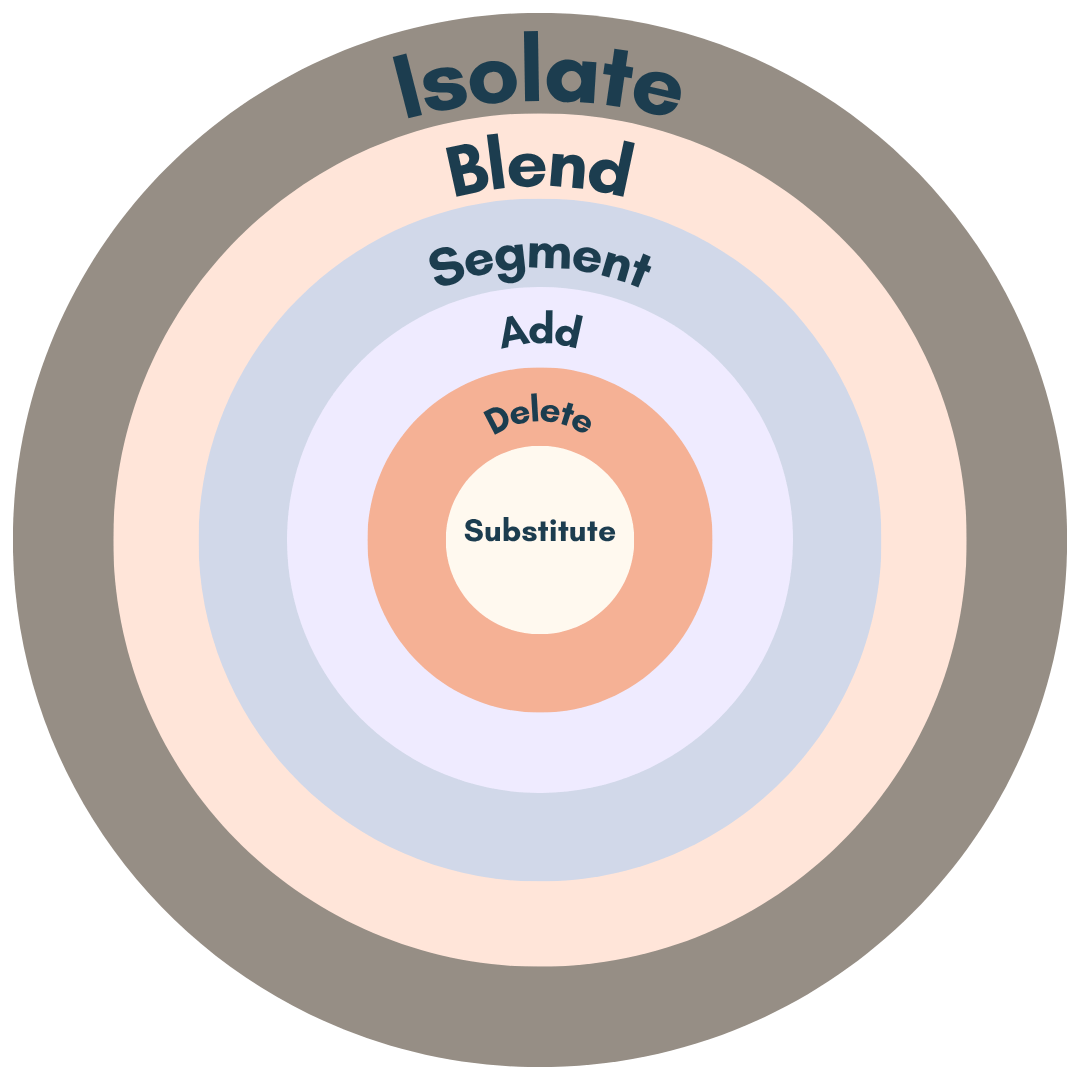
Most people want to immediately aim for the middle of the bulls-eye. That is, they want to work on mastering sound substitution. (Eg. "Say blast. Change the /a/ into /e/. What's the new word?" Blessed)
But you don't have to get your kid to hit that bulls-eye to get them reading and spelling.
You just have to get them blending and segmenting.
The more advanced phonemic awareness skills - adding, deleting, and substituting sounds- are associated with the strongest readers, but this is likely a result of reading and spelling, not a prerequisite.
The PA skills that actually build reading and spelling are blending and segmenting. These are the skills that bring about gains in our reading and spelling skills. This is ESPECIALLY true when we combine blending and segmenting activities with letters.
In other words, training kids to add, delete, and substitute sounds will lead to better phonemic awareness, but not necessarily better reading and spelling.
But training kids to blend and segment sounds, and letters, will translate into better reading and spelling. And that's what we're going for!
Blending Sounds Explained
Let's start with blending. We take two separate speech sounds, and then we run them together, saying them in one burst, without the space in between.
Examples:
/i/ + /n/ = in. Should we go in the house?
/A/ + /k/ = ache. I have an ache in my tooth!
/sh/ + /O/ = show. Can I show you a trick?
/m/ + /I/ = my. That's my toothbrush!
/t/ + /OO / = two. My brother is two years old!
/g/ + /O/ = go. Ready, set, go!
/f/ + /u/ + /n/ = fun. That was so much fun!
/f/ + O/ + /n/ = phone. Have you seen my phone?
/s/ + /a/ + /d/ = sad. That boy looks sad.
/t/ + /I/ + /m/ = time. Do we have time to do a puzzle?
/p/ + /o/ + /p/ = pop. Pop goes the weasel!
Notice that when we combine the sounds, our mouths sort of "melt" them together where they connect, and that can mean that the sound shifts just a bit.
For example, if you hear the /t/ sound at the beginning of "top" and the /t/ sound at the end of "hit", they are slightly different. When we practice blending, it helps to use the same sound in different words, so kids can practice hearing and saying the different variations of the same individual sound. This way, kids can begin to hear how the individual /t/ counts as the same sound as the /t/ in top and the /t/ in hit.
If your child can hear how sounds connect into words, then they can use letters of the alphabet to represent whole words, not just individual sounds! This is where the ABCs really come alive and make sense to early readers.
Segmenting Sounds Explained
Segmenting is the opposite of blending. We hear a single word, and we divide it up into the individual speech sounds that make up that word. We put the spaces in between sounds, where there weren't any spaces before.
Examples:
ice = /I/ + /s/
chai = /ch/ + /I/
tea = /t/ + /E/
boy = /b/ + /oy/
kit = /k/ + /i/ + /t/
peach = /p/ + /E/ + /ch/
rake = /r/ + /A/ + /k/
math = /m/ + /a/ + /th/
fin = /f/ + /i/ + /n/
date = /d/ + /A/ + /t/
Did you notice anything familiar about this task?
It's the exact same thing as the blending skill, but in reverse. We are asking students to analyze a whole word and its corresponding, separable parts. These parts are crucial, because those are what the letters represent.
Red Flags for Blending or Segmenting Sounds
If your kiddo is having a hard time blending or segmenting, here's what you might see at home:
Reading Red Flags:
-Repeating the individual sounds without connecting them after you've asked them to blend a word, or only partially blending the word (c + a + t = "c…a…t" or "ca….t")
-Making frequent errors reading words with known letter sounds
-Using the first letter in the word and then "guess" the rest
-Not remembering the first sound in the word by the time they've looked at the middle and last letters
-Can't read nonsense words with familiar real-word patterns (eg. can read sit, pit, bit, but not vit, rit, dit)
Spelling Red Flags:
-Spelling the loudest or the clearest sounds in a word, but skipping over vowels or softer sounds (eg: dg for dog, sin for spin, at for act, chn for train)
-Not telling you all of the sounds in a spoken word when asked
-Not counting how many sounds are in a word when asked
-Can't spell nonsense words (eg. hun, pab, tig) with familiar patterns
How to Help Your Kid At Home
If your kiddo is struggling to work with the individual sounds in words, it can help to do a couple of things.
First, we want to relieve some of the pressure by taking the difficulty level down.
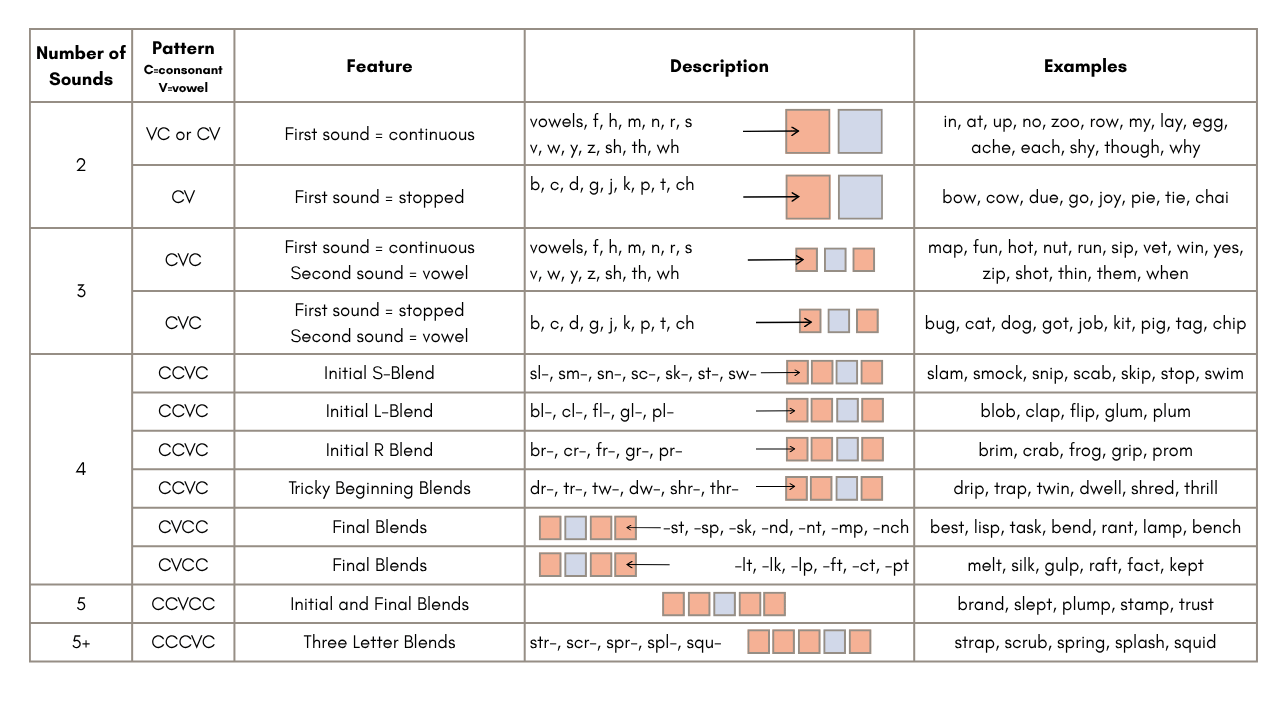
This means that if your student is struggling to blend or segment words like "stiff" or "mask", drop back to words with fewer sounds, like "sit" and "mat."
If your child is struggling to blend "cat" and "top", drop back to "at" and "in", and other words with 2 sounds.
In other words, bring it back to a zone of confidence. Pronto.
When your student is no longer showing those red flags listed above, and is confidently and correctly blending, then you can move on to the harder words.
There are lots of multisensory ways to help kids understand and practice blending and segmenting sounds. You can practice this skill without using any letters, and just relying on physical objects to represent sounds.
Some crowd favorites are Lego or Duplo blocks, Magnatiles, Sound Slides, and toy cars. Grab as many of those items as you have sounds in your target words, and crash them together! Blending sounds can be visually demonstrated by bringing objects together. Segmenting sounds can be demonstrated by taking them apart.
For kids who can remember the sounds that you "assign" to their toys, this is a good way to take some of the pressure off.
First, start with words that have 2 sounds and start with a vowel. Seems easy? That's exactly what we want. You'll gradually increase the difficulty, but at a slow pace, maintaining solid skills and confidence.
Next, only use words with letters that maintain their primary sounds. (Eg. cat, mint, stop all have the sounds we expect from those letters; of, the, as, ache, by have unexpected sounds, and shouldn't include letters until you're ready to explicitly teach those spellings.)
Use this guide to choose the kinds of words that your child can work on comfortably. This guide starts with the easiest kinds of words to blend, and gradually increases in difficulty as you move down.
Should We Use Letters When We Work on Blending and Segmenting?
Yes! And also, no.
If your child confidently knows a handful of letters and their sounds, and is only struggling to actually blend or segment them, it's a good idea to use the letters within the activities!
But if their letters are not solid yet, you don't have to use them. You can use manipulatives to represent sounds and stick those together.
For example, you can use a sound slide to practice blending the sounds to make "at". There are two ways to do this:
- No Letters = Place a peg doll at the top of the sound slide, and another peg doll at the bottom of the slide. The first peg doll's name is "/a/" and the second peg doll's name is "/t/". Slide "/a/" down the slide while holding that sound, and then say "/t/" as you crash into the second peg doll.
- Letters = Place the letter tile "a" at the top of the slide, and the letter "t" at the bottom of the slide. As the letter "a" slides, say the /a/ sound and hold it all the way down. Without pausing, say /t/ when you crash into the letter "t" tile.
You see, you can actually train your kid's ears and mouth to stick sounds together and take them apart, even if they haven't learned the letter sounds solidly just yet.
This is actually a great way to work on words that have phonics patterns you likely haven't taught yet, such as ache, thigh, row, paw.
It's also a great way to practice phonemic awareness in a non-threatening, non-schoolish way. This is good for students who are resistant or insecure and need some emotional stability. Fun, play-based activities without letters can settle a student's nerves and bring them back to a neutral place.
But as SOON as they have the letter sounds down pat, bring those into the activities. We ultimately want these phonemic awareness skills to bring about reading and spelling skills, and using letters is the best way to do that.
So, in conclusion, we don't need students to win any gold medals in phonemic awareness darts.
They don't need a Ph.D in Advanced Phonemic Awareness.
They just need the blending and segmenting skills in order to become solid readers.
In the next post, we'll dive into some specific activities that you can do to strengthen blending and segmenting at home!
If you'd like to just turn your brain off and follow a beginner-friendly set of blending lessons, grab my free Blending Sounds Starter Kit. I'll show you simple, no-letter activities that you can do at home to help your child blend 2 and 3 sounds together, without worksheets, pressure, or long lessons.
Need help getting your kiddo to blend sounds together? Check out the at-home activities in Teach Your Kid to Blend Sounds