Phonemic Awareness in Reading: A Parent's Guide
Jul 14, 2026
Lots of students who struggle to read the words on a page have a common, underlying issue.
That, my friend, is an issue of phonemic awareness.
WITHOUT going into full nerd mode, let's take a nice, high-level view of phonemic awareness and why it's so important in learning to read. I'll try to be cool about it.
(But I'm really excited!!!!!)
You've heard the term "phonemic awareness" and, so far, it feels like a jazzy buzz word people throw around at parties to sound smart.
It is that. But it's also a real thing.
Ready to take notes?
Phonemic Awareness Defined
Phonemic = related to phonemes. A phoneme is the smallest, individual speech sound that can be distinguished from other phonemes in a given language. In English we have 44 ish phonemes-that is, 44 sounds that are different enough from each other that we can tell them apart (eg. the /b/ in bat is different from /p/ in pat; the /i/ in fin is different from the /I/ in fine, etc.
Awareness = being aware, or sensitive to. Knowing something exists, being able to study it.
So phonemic awareness means being aware of the tiniest speech sounds inside of words in one's own language.
When your kiddo learns whole words, like "mama", "dada,"baba", and "no," those are individual units of meaning. They can distinguish those particular sounds, in order, from other sound combinations. We love it when kids are aware of words, and use them!
But as we prepare for literacy, kids have to get a lot more detailed in their knowledge of language.
You know those ridiculous glasses the dentist wears to see inside your mouth? Imagine we all have that, but for our ears. Not only can we hear and appreciate different words, but we can hear and appreciate the different sounds inside of those words.
We can tell, for example, if someone has mispronounced a word. We can tell if words rhyme-not by seeing them written, but by hearing the similar sounds at the middle and end of the words.
What is phonemic awareness in reading?
It's the reason our alphabet is useful to us.
Since letters represent sounds, we have to know what word we get when we combine multiple sounds.
And when we spell, we have to take apart the sounds we hear in a single word so we can write down each sound's representation.
That's how the English writing system works (...mostly…it's more complicated than that, but let's just keep it simple for now. In beginning reading, the letters usually make their expected sounds).
For example, we have to hear and recognize the single sound that distinguishes "big" from "dig" in order to understand the letters that spell those words.
So I want you to think about two sides of the same coin. On one side, we have the familiar "A says /a/" that most parents and teachers start with. Kids really need to know that the letter A says /a/!
On the other side of the coin is knowing that /a/ is the first sound in "apple." This is the part we take for granted.
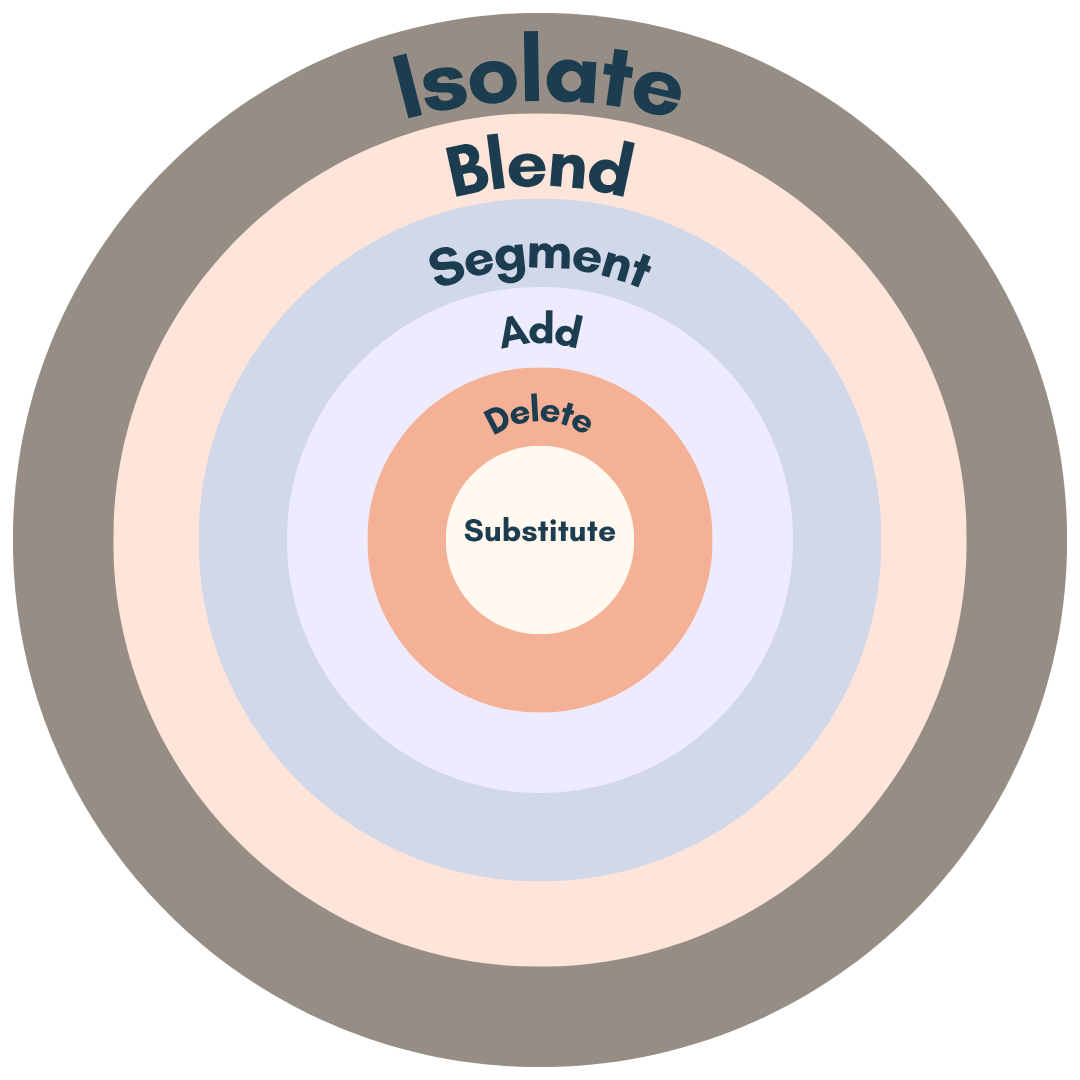
There are 6 layers of phonemic awareness that range from simple to complex. The easiest skill to teach and learn is isolating a single sound. The most difficult is substituting sounds. Here's a handy graphic:
Dyslexia and Phonemic Awareness
Weak phonemic awareness is one of the most common underlying problems we see in students with dyslexia.
Students who have a hard time working with individual sounds in words, and the letters that represent those sounds, will likely have a hard time reading and spelling, even without a dyslexia diagnosis.
BTW-This is not universally true of all people with dyslexia-there are a few other things that can contribute to poor reading. But phonemic awareness is THE BIG ONE.
Phonemic Awareness Can Be Taught
Yes!!! PA is one of the highest-impact skills we can strengthen, and one of the most responsive to intervention.
PA is not a "lightbulb moment" skill-it develops gradually over time. A few minutes of practice each day over a few weeks can really make a huge difference.
It helps to let your child copy you as you take sounds apart or put them together. Gradually guide your child to hear and say the sounds in words.
And bonus-your child doesn't need to fully master adding, deleting, or substituting sounds before they can become a reader. The most critical PA skills for reading and spelling are blending and segmenting, and you can go straight into those, no matter where your student is starting from.
Signs Your Child Might Need to Work on Phonemic Awareness
- has trouble recognizing rhymes
- struggles to blend sounds like "/f/, /i/, /sh/ into "fish"
- guesses at words
- has trouble hearing the first sound in a word (or the last sound, or the middle sound)
- struggles to spell simple words, even after learning letters
- remembers letter sounds but can't use them to read words
Phonemic Awareness Practice at Home
- What is the first sound in "sun"? (/s/) -> Isolating
- Do cat and cup start with the same sound? (yes!) -> Isolating
- "what word do these sounds make? /I/, /s/? (Ice) -> Blending
- How many sounds are in "book"? (3: /b/, /oo/, /k/) -> Segmenting
- What do we get when we add /s/ to the beginning of "mash"? (smash) -> Addition
- What do we get when take /ch/ away from "pinch"? (pin) -> Deletion
- What happens if I take the word "glass" and change /a/ into /o/? (gloss) -> Substitution
These kinds of questions target the different layers of phonemic awareness. When you're teaching these concepts, it helps to use physical materials. For example:
- use 2-3 lego blocks or magnetic tiles to represent sounds that you can stick together or break apart
- use a Sound Slide to show sounds rushing together
- make a pretend remote control to "pause" after the first sound in a word
- "this hand says /o/, and this hand says /f/." CLAP! "What word do they make together?" (off)
Should I Use Letters When Working on Phonemic Awareness?
It is absolutely beneficial to use letter tiles, letter cards, or magnet letters in your activities. This builds phonemic awareness, but also strengthens phonics. It can also really help your child remember the sounds they are working with.
If your child already knows the letter sounds, and can easily recognize those letters, go ahead and use 'em in your activities!
If they don't yet feel confident with letters, you can use blank tiles, blocks, and toys that don't have any letters on them. You can absolutely practice combining and taking apart sounds using just the oral sounds and manipulatives to represent those sounds.
As your child begins to learn letters, it's a great idea to incorporate those into your phonemic awareness activities!
If your student gets frustrated with reading, starting with sounds only can feel way less intimidating. There are no books, no worksheets, no writing-this can feel a lot more approachable to a struggling reader. As your child's confidence grows, bring in those letters.
Want some help getting started? Grab my free Blending Sounds Starter Kit. I'll show you simple, no-letter activities that you can do at home to help your child blend 2 sounds together, without worksheets, pressure, or long lessons.
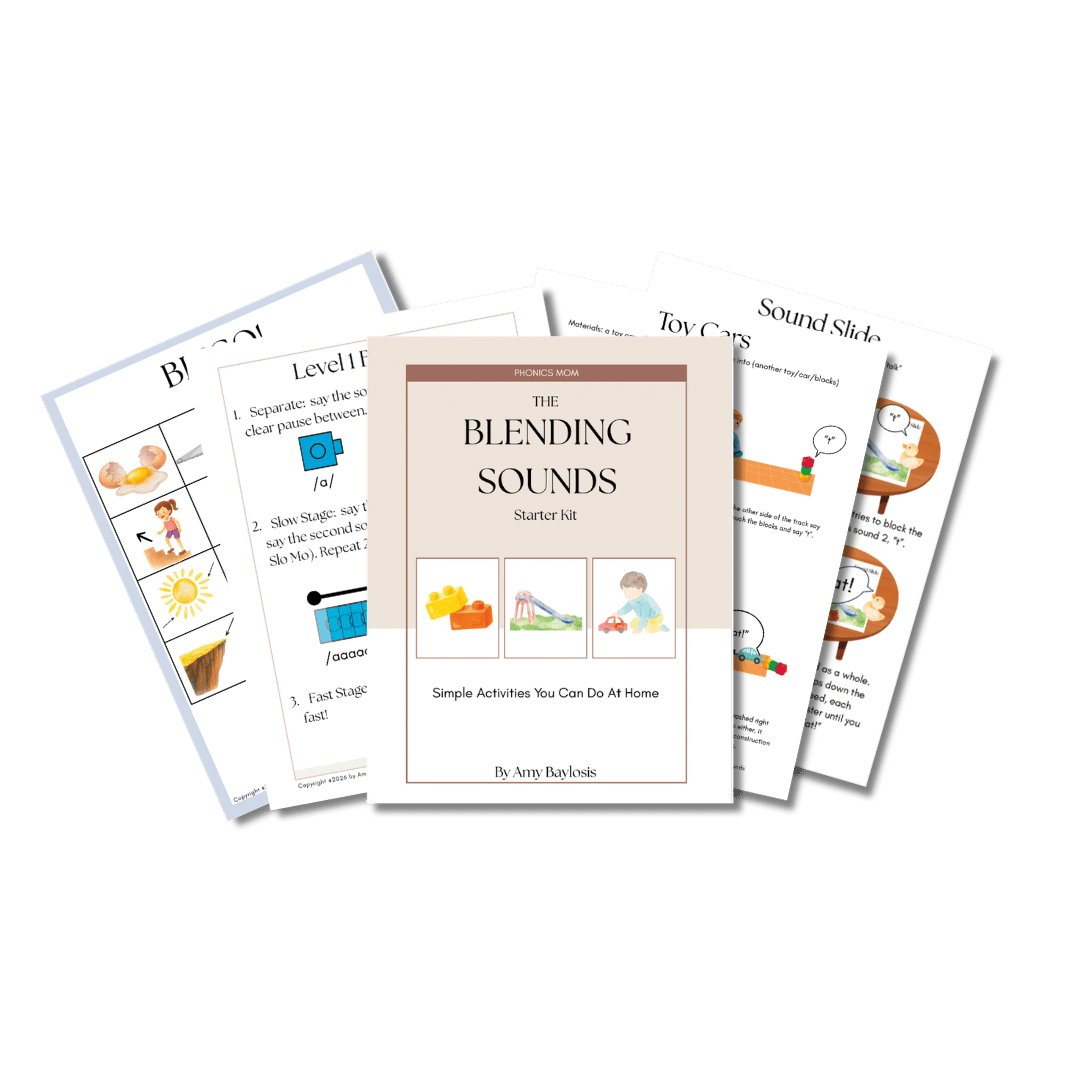
Need help getting your kiddo to blend sounds together? Check out the at-home activities in Teach Your Kid to Blend Sounds