Rhyming Skills: Are They Really Needed for Reading?
Aug 27, 2026
Lots of parents are aware of rhyming words as one of the early indicators of a child's readiness for reading. We get so excited when our kids can laugh along to the Cat in the Hat with us!
Some kids can list off 10 rhyming words for any word we give them, and they seem to be ready to read!
Other kids can sense when words rhyme, but if you ask them, "What rhymes with log?" you get a blank stare or a wild guess.
Still others aren't really laughing at the rhyming patterns in books, and it's clear they don't really hear the phenomenon of rhyming.
How worried should you be, as a parent, if your child falls in the second or third category? We'll go into the answer (spoiler-not very worried) and explain why we can still move forward teaching literacy even if our kids cannot yet produce rhymes.
In order to do that, we'll explore phonological awareness and phonemic awareness. It's not as boring as it sounds, I promise.
Phonological Awareness vs. Phonemic Awareness
I know-these two terms sound really similar to each other. They're both jargon-y, and they both deal with sounds and reading. They're related, but not identical.
Phonological awareness is a broad group of skills that lets us perceive and manipulate the sounds in our own language. These skills are grouped into 4 categories that start pretty big and get pretty tiny. They include word awareness, syllable awareness, onset-rime awareness, and phonemic awareness. Check out this handy illustration of the umbrella term "phonological awareness" and its four components:
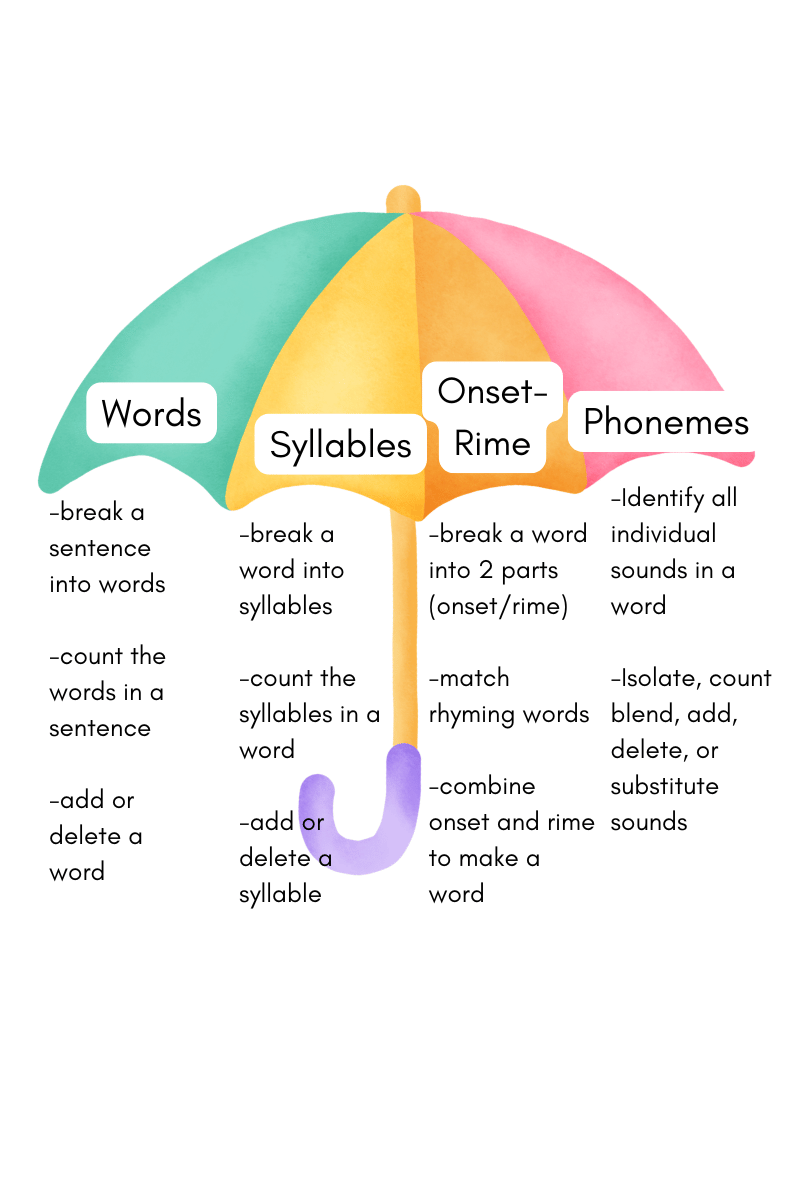
So phonemic awareness is the last, and most detailed, level of phonological awareness skills. Not the same as phonological awareness, but a component of it.
The reason we care about these terms is because kids have to be aware of the different parts of language that exist in spoken English. This allows them to make use of the written code. We'll take a look at each of these levels of phonological awareness below:
Phonological Awareness Levels
Level 1: Word Awareness
This is the most broad skill under the umbrella.
This is the realization that words are separate from each other and can be changed around to make different meanings. Hearing "Nothankyou" as a young toddler might seem like it's all 1 word.
As kids grow, they learn to realize that "No" is separate from "thank" and from "you." The boundaries of the word contain the entire meaning of the word.
One way we build word awareness is by counting words.
At first, the words should all be 1 syllable
"Tom is at school" = 4 words.
But then, we add words with 2 or more syllables.
"Lily is at school" = also 4 words.
"I see a butterfly on the flower" = 7 words
If your child tries to count parts of a word, like "but" from butterfly or "flow" from flower as words, ask them, "Do you see a but? Or a butterfly? Do you see a flow" Or a flower?" Words can be long or short, but they have to have meaning on their own.
Level 2: Syllable Awareness
Syllable awareness is the understanding that syllables are organized around a "beat" of speech Sometimes that beat is recognized as having a single vowel sound, and sometimes that is not yet understood. It sort of doesn't matter.
For example, did you know that syllables are expressed as having a single vowel sound? Probably not, and yet, you can count syllables because you just get it. Someone probably modeled clapping, or jumping, or counting syllables and you just recognized what was being observed with the movement.
Syllable awareness also allows students to recognize that a single word can have multiple syllables. For example, "bug" is a single syllable as well as a single word, while "butterfly" has 3 syllables, but is also a single word.
Level 3: Onset-Rime Awareness (Rhyming Skills Live Here!)
Here's where Dr. Seuss really shines-by capitalizing on the emerging awareness of rhyming words.
To be clear, rhyming words simply sound the same from the vowel and onward. They aren't necessarily spelled the same in that same spot.
Examples:
Bite/fight, sleigh/bay, tone/own, crypt/flipped all rhyme, despite having different spelling patterns from the vowel and onwards. The trick is that they sound the same in the middle and end.
Rimes, however, are the actual spelling pattern from the vowel onward. So the rime is a portion of a syllable that starts from the vowel sound and continues to the end.
Examples:
-at (as in cat, hat, mat)
-ome (as in dome, home, Rome, but not some)
-ork (as in cork, spork, stork, but not work)
|
Word |
Onset (all the consonants before the vowel) |
Rime (the vowel is always first) |
|
mat |
m- |
-at |
|
fat |
f- |
-at |
|
splat |
spl- |
-at |
|
time |
t- |
-ime |
|
grime |
gr- |
-ime |
|
chime |
ch- |
-ime |
|
stork |
st- |
-ork |
|
shrimp |
shr- |
-imp |
|
rush |
r- |
-ush |
When students begin to hear that individual syllables can be further broken down, and recognize those same ending sounds across multiple words, then they can enjoy those Dr. Seuss books and rhyming games.
Some students can hear and recognize that 2 words rhyme, even if they cannot yet come up with rhyming words.
Do dog and log rhyme? (Yes)
Do rich and wish rhyme? (No)
What word rhymes with "chance"? (dance, pants, ants)
It's important to know that children can listen for rhymes in both real and nonsense words. For example:
Do shrip and blip rhyme? (Yes)
What word rhymes with crop? (mop, trop, smop)
The goal is the recognition of the sameness of sounds in the correct portion of the word, not the realness of the words themselves. As kids grow their knowledge of language, they can later produce words that rhyme by applying the sounds needed to rhyme.
Level 4: Phonemic Awareness (Required for Reading!)
At last, the most detailed level of phonological awareness! This is the big kahuna of reading and spelling skills, and it's what allows us to use letters to connect to the words we speak. Phonemic awareness is the ability to perceive and manipulate individual speech sounds (aka phonemes).
We go in to phonemic awareness more deeply in this blog post, but I'll give a brief set of examples of the 6 skills within phonemic awareness:
|
Phonemic Awareness Skill |
Example 1 |
Example 2 |
|
Isolate a beginning sound |
what's the first sound in sun? (/s/) |
What's the first sound in spun? (/s/) |
|
Blend Sounds |
What word do we get when we blend /i/ + /ch/? (itch) |
What word do we get when we blend /s/ + /t/ + /r/ + /e/ +/ch/? (stretch |
|
Segmenting Sounds |
How many sounds are in the word "cook"? (3) |
What are all of the sounds in the word "splash?" (/s/ + /p/ + /l/ + /a/ + /sh/) |
|
Adding Sounds |
Add /s/ to the beginning of "lab". What's the new word? (slab) |
Add /n/ before the last sound in "had". What's the word? "hand" |
|
Deleting Sounds |
Say "brace" without /b/. (Race) |
Say "date" without /t/. (day). |
|
Substituting Sounds |
Say "chip." Now change /i/ into /o/ (chop) |
Say "flinch." Now change /ch/ into /t/ (flint) |
The table above describes phonemic awareness skills from simplest to most complex. The first three skills are priority numero uno for learning to read and spell.
(The last three skills tend to develop alongside skilled reading, not prior to it.)
So when we're learning our ABCs, we're also learning (hopefully) that the words we say are made up of individual speech sounds, and we can attribute letters or letter combinations to those sounds.
We need to be able to blend individual sounds together in order to read words. In other words, if your student can hear the sounds /i/ and /n/, we need them to smoothly connect those into the word "in". This can be practiced without actually using letters, since this is an auditory and oral activity. However, it helps a lot to use the letters themselves if kids know them.
We also need to break a whole word into its individual sounds in order to spell. If your student can hear the word "fish", we want them to perceive and isolate /f/, /i/, /sh/ and recognize those are 3 different speech sounds. This skill is also auditory and verbal in nature, but is also helped with the use of letters.
Rhyming Skills and Reading
You may have heard that your child needs to be able to rhyme words before they can start reading. I'm here to tell you that is simply not true! Rhyming is a skill that reflects some awareness of how parts of words can sound the same as other parts of words. But it's not required that your kiddo can generate rhyming words before they can start working with the individual sounds in words.
In other words, that can begin reading without yet being able to come up with rhyming words themselves. In fact, with my tutoring clients, I don't work on rhyming much at all until kids are already pretty solidly blending and segmenting individual sounds.
Although rhyming is technically in the "simpler" category of phonological awareness, it is not directly doing the heavy lifting for reading or spelling. It is also a legitimate predictor of later reading achievement.
But that doesn't exactly mean that rhyming itself is a required prerequisite skill, or a primary goal, for reading instruction. Rhyming becomes easier to hear and produce for some kids as they learn to be attuned to sounds in words.
In fact, I recommend that students go straight to phonemic awareness when they start formal instruction in school, regardless of how strong or weak their rhyming skills are.
So does the IDA in their article about phonemic awareness, which you can read here.
So does Dr. Tim Shanahan as he refers to the National Early Literacy Panel findings of 2008, which you can read about here
If your kiddo isn't rhyming yet, don't panic! Keep having fun playing word games, reading fun stories, and listening to the sounds in words.
And remember that you don't need to hold back on teaching individual blending and segmenting-jump into that as soon as your child can successfully manage working with individual sounds.
Need help getting your kiddo to blend sounds together? Check out the at-home activities in Teach Your Kid to Blend Sounds